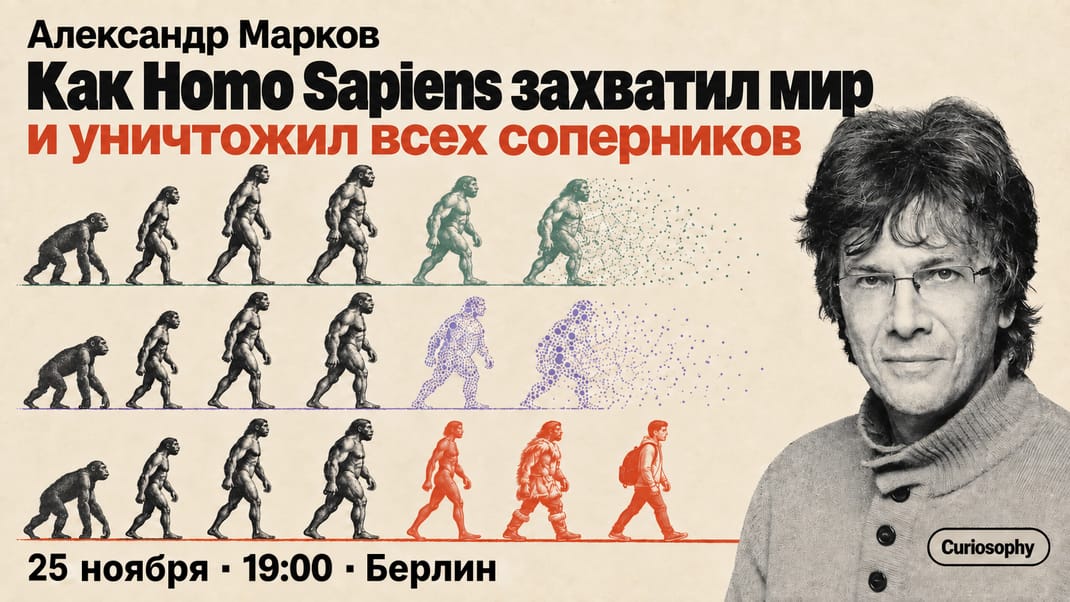
How Homo Sapiens Took Over the World and Eliminated All Rivals

Alexander Markov will give the lecture “How Homo Sapiens Took Over the World and Eliminated All Rivals” — 25 November 2026, 19:00, Coworking Space TUECHTIG. Tickets from €32.
About the lecture
Only quite recently — by the standards of human history — we were not alone. On Earth, at least three humanities existed at the same time: sapiens, Neanderthals, and Denisovans. They had common ancestors, but hundreds of thousands of years of evolution spread them across different parts of the Old World. Neanderthals populated western Eurasia, Denisovans the east, while the ancestors of modern humans remained in Africa for a long time. Who were these people? What could they do? How different were they from one another? Where did they meet, and what did they adopt from each other? Why, despite the huge distances between them, do archaeologists find a surprising cultural similarity? And then the balance was disrupted. In the Middle East, sapiens developed new technologies and weapons. The Upper Paleolithic begins. Sapiens more and more often move beyond Africa, penetrate into Asia and Europe — and gradually a world inhabited by different human species turns into a world of one humanity. Why did Neanderthals and Denisovans disappear? Was the cause sapiens’ technological superiority, demography, climate, chance — or all at once? And did the other humanities really disappear, if part of their DNA still lives inside us?
Alexander Markov will tell this story as a scientific detective tale. We will piece together a picture of the past literally from grains of information — bones, stone tools, sites, and fragments of ancient DNA. And we will see how the discoveries of archaeologists and paleogeneticists are changing right now our ideas about how sapiens became the last humans on Earth.
Alexander Markov is Doctor of Biological Sciences, a specialist in evolutionary theory, a paleontologist, a popularizer of science, and the author of many popular-science works. Listen to the KontrEvolyutsiya podcast featuring Alexander Markov about alternative scenarios of human development.
Part of a tour · 5 more cities
This lecture takes place in 6 cities